
Luck Surface Area, Revised
The startup formula everyone uses is wrong.

If you’ve been around start-up and entrepreneur culture you’ve probably heard of this or have seen the formula. Jason Roberts coined it in 2010 and it’s been circulating through startup culture ever since:
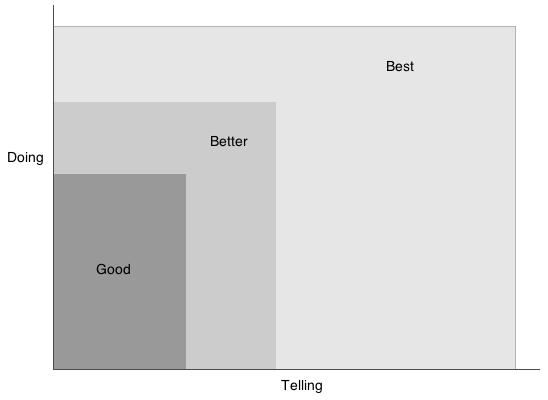
L = D × T
Luck equals Doing times Telling.
Do things. Tell people about them.
The more you do and tell, the more “surface area” you create for luck to land on. It’s clean, intuitive and actionable.
It’s also wrong. Not in what it says, but in what it assumes.
“Surface area” is a geometric concept. Roberts uses it as a metaphor for exposure: more effort, more area, more luck. But he’s actually calculating something much simpler than surface area. He’s calculating a rectangle. Length times width. D × T.
That’s a footprint. And a footprint is only the same as surface area when the surface is flat.
Consider a sheet of paper lying on a desk. Its footprint and its surface area are identical. Now crumple that paper into a ball. The footprint just got smaller. But the surface area hasn’t changed. In fact, depending on how tightly you fold it, the surface area within that smaller footprint can be vastly greater than the flat version.
This is not a metaphor. This is what’s actually happening in the environments where founders spend their time.
A coworking space is not flat. It is a textured space with dynamic aspects. You show up - same effort as posting on LinkedIn, maybe less - and the architecture does something Roberts’ formula doesn’t account for. The shared kitchen area creates a fold. The hallway creates a fold. The overheard conversation, the moment someone catches you between calls… Each of these is an encounter surface that your effort alone didn’t produce. The environment produced it.
The space is textured, folded, like this:
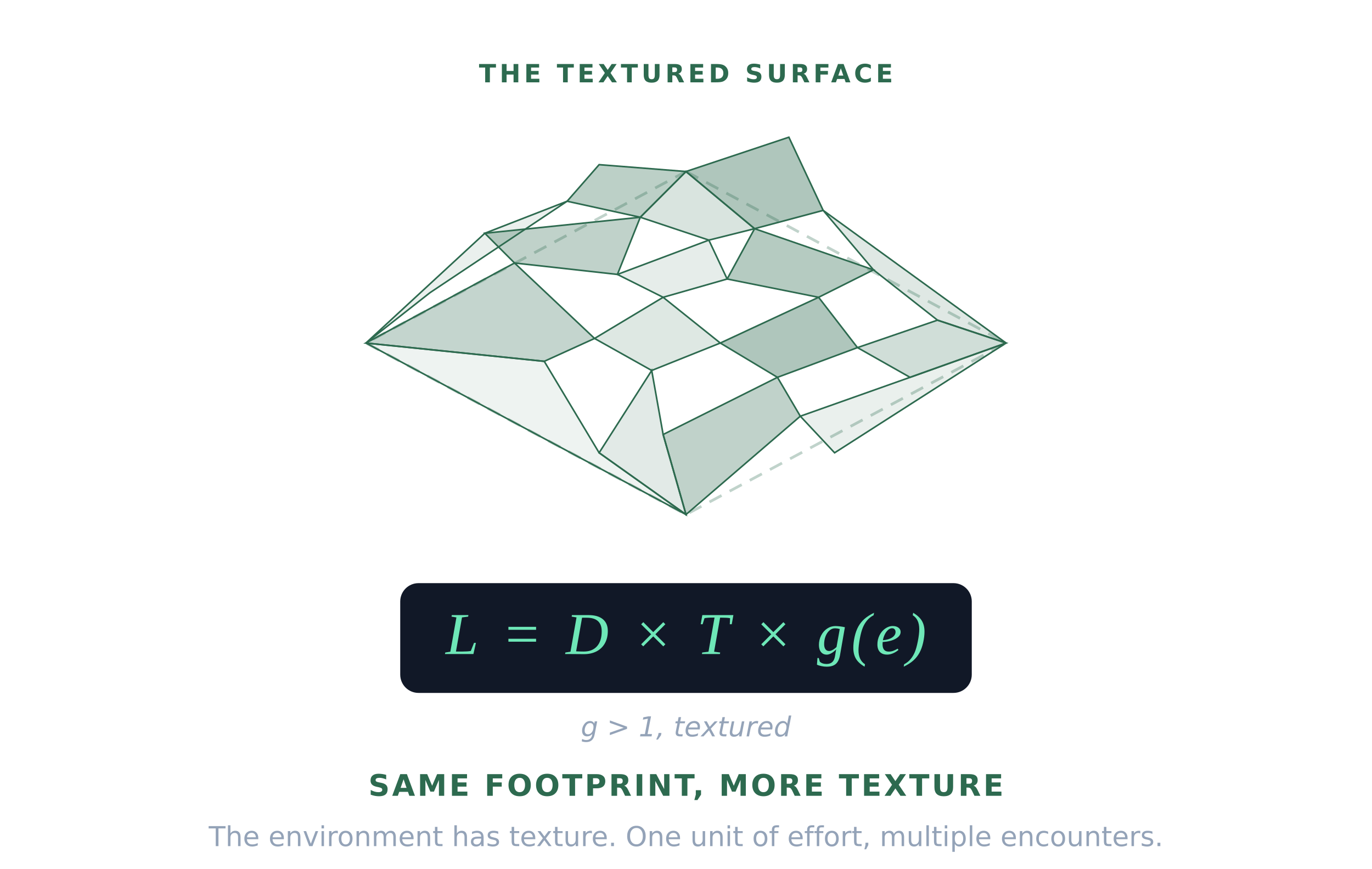
One unit of “doing” generated multiple encounter surfaces because the geometry was folded.
Now think about a pitch night. You’re working hard. Doing intensely, telling constantly. By Roberts’ formula, your D × T is enormous - probably the highest of any environment on a per-hour basis. You should be generating massive luck surface area.
But every encounter is pre-formatted before it begins. You meet someone and they’re already in pitch mode. You’re in pitch mode. The event decided the shape of the interaction before either of you opened your mouth: who are you, what do you do, what do you need. The conversation has rails.
The format irons out the folds. There are no kitchen encounters at a pitch night. No hallways where someone catches you unguarded. The geometry is dense but smooth - high footprint, low actual surface area.
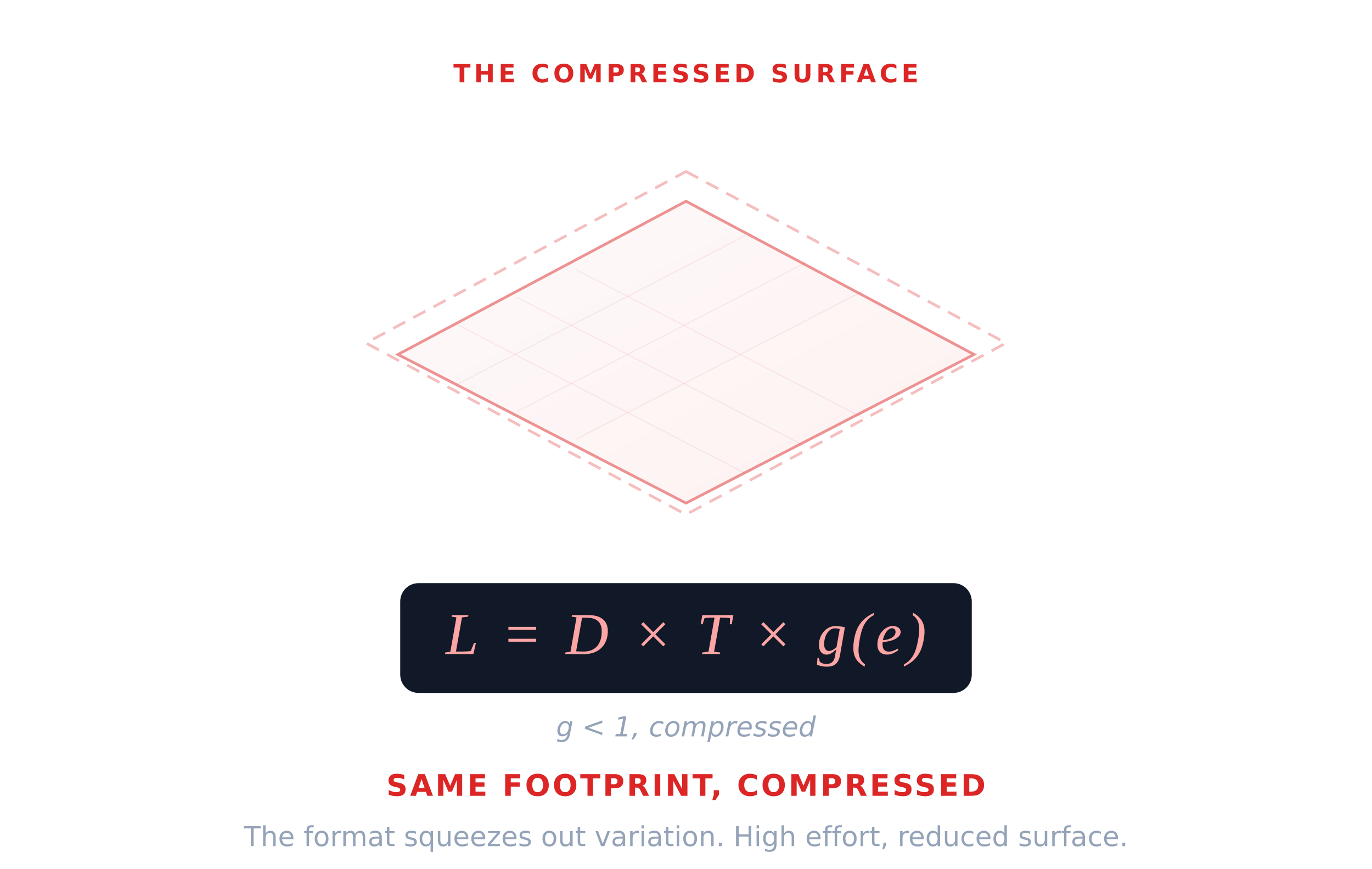
You can work harder and get less lucky if the geometry is wrong.
That is what Roberts’ formula misses. It treats the environment as neutral - a blank surface that you expand through effort. But the environment is not neutral. It has a geometry. And that geometry determines the conversion rate from effort to encounter.
The revised formula is simple:
L = D × T × g(e)
Where g(e) is the geometric coefficient of the encounter environment. When g is greater than 1, the environment folds - it multiplies your encounter surface beyond your effort. When g is roughly equal to 1, Roberts’ formula holds - flat geometry, effort in equals encounters out. When g is less than 1, the environment smooths - it reduces your encounter surface despite your effort.
The question was never how do I increase my surface area?
The question is: what is the geometry of encounter in this environment and what shapes does it make possible?
Roberts’ formula was built for one specific geometry: the broadcast. Do things, tell people — distribute your signal to more receivers. This made sense in 2010. Telling was distribution the medium was flat by design.
But most of the environments founders actually inhabit aren’t flat. A coworking space is textured and folded. A Slack community is porous. A demo day is smoothed. And an algorithmic feed — the one environment that looks most like Roberts’ model — is flat in a way he didn’t intend: the algorithm determines the shape of your encounters without your input, optimizing for engagement probability rather than serendipity.
Each of these environments has a different geometric space. Each converts your effort into encounter at a different rate, in a different shape, with different structural limits. The founder who spends three hours at a coworking space and the founder who spends three hours at a networking event have done the same amount of “doing.” Roberts’ formula says they’ve generated the same luck surface area. They haven’t. They’ve generated different shapes of luck — and one of them may have generated less surface area despite equal or greater effort.
None of this is an argument against effort. Roberts was right that doing and telling matter. But they’re not the whole equation. The environment is the missing variable - the one that determines whether your effort lands on a surface that folds, flattens or smooths.
If you’re a founder reading this, the practical implication is straightforward: look at where you spend your time and ask what geometry each environment produces. Not how many people you can reach. Not how many events you can attend. What shape of encounter does this environment make possible - and what shapes does it limit?
The answer isn’t to choose one geometry. It’s to know what each one produces, to understand the structural trade-offs and to stop assuming that more effort in the wrong geometry produces more luck.
May, 2026 UPDATE:
As part of a funded research project through Langara College, I am collecting Founder feedback. I appreciate your contribution with this short survey: https://docs.google.com/forms/d/e/1FAIpQLSdoKpCgA1AKArETrQwTViI8Syy2S1i5sn9lIcL0u7Vytdn3lQ/viewform?usp=header